
Borobudur Buddha Statue Facts: Understanding the Sacred Figures
The Borobudur Buddha statue facts reveal another important part of this ancient Buddhist monument. Buddha statues appear throughout different levels of Borobudur and form an important connection between its architecture and religious symbolism. Their positions, surroundings, and placement inside stupas make them fascinating features for visitors exploring the monument.
Buddha Statues Appear Across Borobudur
Buddha statues are distributed throughout several sections of the monument. Visitors can find them inside niches along the square terraces and within the perforated stupas on the upper circular platforms.
Their repeated placement creates a strong visual pattern across the temple. The statues also help connect the various architectural levels.
Rather than placing the figures in one central location, the builders incorporated them into the overall structure of Borobudur.
Statues Sit Inside Stone Niches
One of the notable Borobudur Buddha statue facts is the way many statues are positioned inside niches. These niches appear along the walls and balustrades of the square terraces.
The surrounding stonework frames each Buddha figure and provides a consistent architectural setting. As visitors walk through the galleries, they encounter statues repeatedly along the pathways.
This arrangement allows sculpture and architecture to function together as one continuous design.
Buddha Statues Also Appear Inside Stupas
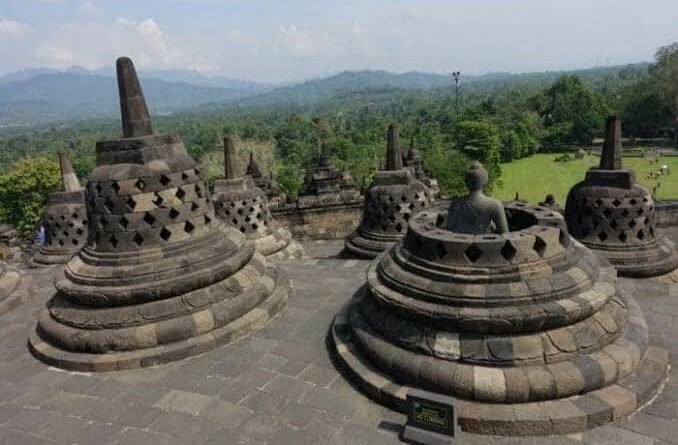
The upper circular platforms provide a various setting for Buddha statues. Many of the perforated stupas contain Buddha figures inside their stone structures.
The lattice-like openings partially reveal the figures from outside. Visitors may see the Buddha clearly from one angle and only partially from another.
Walking around the circular platforms therefore creates changing views of both the statues and the stupas surrounding them.
For travelers who want to learn more about Borobudur’s history, architecture, Buddhist meaning, and interesting details, this Borobudur facts guide provides additional information.
Various Hand Positions Have Meaning
The Buddha statues at Borobudur display various hand positions, known as mudras. These gestures carry symbolic meanings within Buddhist traditions.
The arrangement of the figures and their mudras connects the sculptures with the monument’s broader religious concept.
For visitors, noticing the hand positions can add another layer of detail to an exploration of the temple. Instead of seeing the statues as identical figures, travelers can pay attention to their specific characteristics and locations.
The Central Stupa Is Various
The large central stupa at the summit has a various character from the surrounding stupas. It stands without the same perforated design used by many of the smaller stupas on the circular platforms.
This creates a clear visual hierarchy. The Buddha statues within the surrounding structures contribute to the pattern, while the central stupa becomes the dominant element at the top.
The relationship between these features demonstrates how Borobudur uses repetition and contrast throughout its architecture.
Statues Connect Art and Architecture
The Buddha statues are not isolated sculptures placed around the monument. Their locations were incorporated into the architectural plan.
On the square terraces, the figures interact with niches, reliefs, walls, and pathways. On the circular platforms, they become part of the relationship between the stupas and open spaces.
This combination gives the statues an important role in the overall design.
Why the Buddha Statues Matter
The Borobudur Buddha statue facts show how sculpture contributes to the monument’s religious and architectural identity. The statues appear in various settings, display meaningful gestures, and interact closely with terraces and stupas.
Travelers who want to visit Borobudur and other destinations around Central Java can also explore Borobudur Tours.
Taking time to observe the Buddha figures can make a visit more rewarding. Their placement, gestures, and relationship with the surrounding architecture demonstrate how carefully Borobudur combines Buddhist symbolism with ancient Javanese craftsmanship.
